Moving in Western Suburbs of Paris
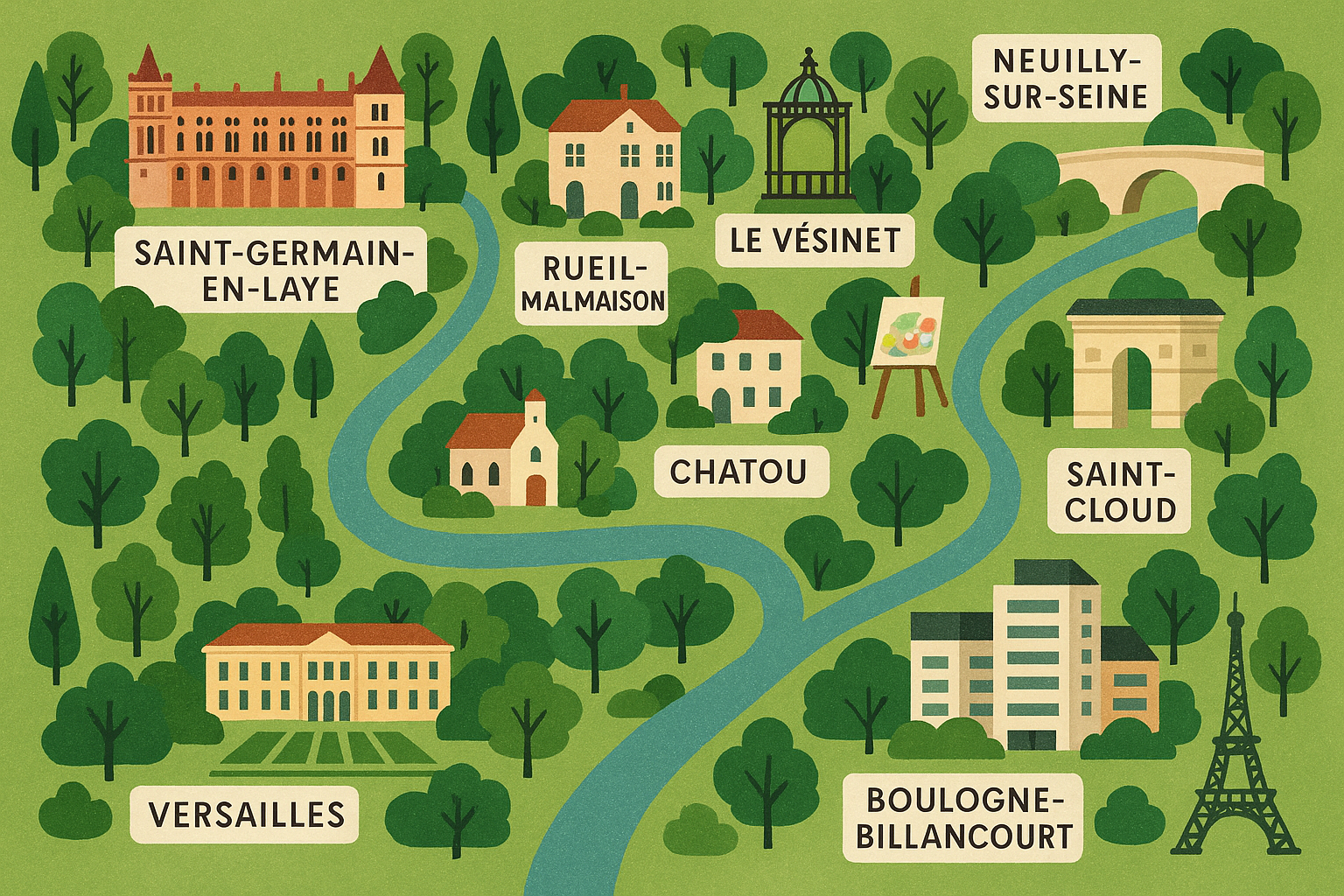
If you're an international family thinking about the western suburbs of Paris, you're looking at an area that combines fast access to Paris, leafy towns, strong international schooling options and very different lifestyles depending on the commune. This guide walks through the pros & cons (international schools, cost of living, presence of international population, transport, housing style) for the key communes people choose: Saint-Germain-en-Laye, Rueil-Malmaison, Maison-Laffitte, Le Vésinet, Croissy, Chatou, Boulogne-Billancourt, Saint-Cloud, Sèvres, Neuilly-sur-Seine, Versailles and Chambourcy, Saint-Nom-la-Bretèche and Marly-le-Roi. We'll also describe the most relevant international/bilingual schools in the area and what they offer.
Quick primer: priorities for international families
- Schools: International, bilingual and public international sections (like the Lycée International Saint-Germain-en-Laye) strongly influence location.
- Transport: RER A is the spine for many western suburbs (fast to central Paris and La Défense); Transilien lines and RER C are also important. Local bus links and driving matter for family logistics.
- International community: towns with big international schools (Lycée International, American School of Paris, British School of Paris) naturally host more expat infrastructure and networks.
- Housing style and budget: leafy towns and villages generally give you more house/garden for the same money than inner ring communes (Neuilly, Boulogne) which are denser and pricier.
Saint-Germain-en-Laye: the international hub
Why families choose it: beautiful town with parks and an outstanding public international option — the Lycée International de Saint-Germain-en-Laye, with 14 language sections and a strong bilingual/trilingual track. This public international lycée is often the top reason families cluster here.
Pros - Lycée International — rare, high-quality public bilingual education and a major draw for families seeking French public education with international sections.
Cons - Extremely high demand for Lycée International placements; admission depends on criteria and available places.
Neuilly‑sur‑Seine: luxe, hyper‑connected, extremely central
Why families choose it: top-tier inner suburb with immediate access to Paris, excellent private services and a very executive/diplomatic population.
Pros - Several international schooling options are available including Marymount International School, which offers a well-established English–French bilingual programme from early years to middle school; École Montessori Internationale de Neuilly-sur-Seine, providing a bilingual Montessori education for children aged approximately 2.5 to 6; and Sainte-Marie de Neuilly, a respected private school with a bilingual English track from collège through lycée alongside the French national curriculum. Superb connections (Metro Line 1, buses), top shops and secure streets.
Cons - Very expensive; mostly apartment living; less green space than Le Vésinet or Saint‑Cloud.
Rueil‑Malmaison: family‑friendly, suburban, well‑placed
Why families choose it: calm residential neighbourhoods, good local services and relatively quick access to La Défense and Paris. Rueil is often a sweet spot for families who want suburban space without being too far from the city.
Pros - Good range of pre-schools and primary schools: Ecole Montessori Internationale for Montessori and bilingual early years/primary and Ecole Montessori Bilingue de Rueil — immersion Montessori from nursery through primary. Short drives and public transport to La Défense and western Paris employment hubs
Cons - Less densely international than areas clustered tightly around the American or British schools, so some expat services are a short commute away.
Maison-Laffitte: riverside, family-friendly, equestrian charm
Why families choose it: known as the "Cité du Cheval" for its equestrian heritage, Maison-Laffitte offers a quiet suburban lifestyle with large houses, green spaces, and easy train access to central Paris. Families are drawn by its village-like feel, safety, and proximity to international schooling.
Pros - Ermitage International School — offers an international curriculum from nursery through primary with bilingual French-English programs, making it a draw for expat families. Good public transport connections (Transilien Line L) to Paris Saint-Lazare.
Cons - Smaller town amenities; fewer shops and cultural activities compared with larger communes.
Le Vésinet: the "ville‑parc": calm, green, premium
Why families choose it: a classic planned park‑city with lakes, tree‑lined avenues, villas and a peaceful centre. Very family oriented and pretty.
Pros - Beautiful green spaces and a safe, walkable fabric for kids. - RER A access delivers direct routes to Paris and La Défense. Malherbe International School is an international primary school, serving early years and primary levels in a largely bilingual program. It's a popular local choice for parents who want a smaller-scale bilingual independent school close to home.
Cons - One of the more expensive small towns for prices per square metre. Fewer international school campuses inside the town — expect short commutes to nearby international schools.
Croissy-sur-Seine: riverside, family-oriented, home to the British School of Paris
Why families choose it: Croissy combines elegant suburban life with proximity to the British School of Paris (BSP), one of the most established international schools in France. It's an anglophone hub with many expatriate families, particularly British.
Pros - Strong international community centered around BSP; family-friendly environment with houses, gardens, and access to the Seine riverbanks; Convenient for both Saint-Germain-en-Laye and Le Vésinet.
Cons - Limited nightlife or big-city amenities; mostly residential.
Chatou: riverfront, villagey, good family housing
Why families choose it: riverside charm, family houses with gardens and close proximity to Croissy and Rueil. Good RER A connection to central Paris.
Pros - More spacious housing stock than inner communes; a genuine village feel. Short RER ride to central Paris. Ecole Perceval is a private school following the Waldorf/Steiner pedagogy, which serves nursery through secondary levels and is prized by families looking for a human‑scale, arts‑and‑hands‑on curriculum, with language learning from early years.
Cons - Fewer large international amenities inside town; some parents commute to nearby towns for major international schools.
Boulogne‑Billancourt: urban, modern, extremely practical
Why families choose it: immediate adjacency to Paris, excellent amenities, modern family apartments and parks; great transport options.
Pros - Fast access to central Paris; lots of children's & cultural activities. Many families who work in Paris live here to maximize walkability and reduce commute times.
Cons - High price per square metre; more apartment living than houses.
Saint‑Cloud: elegant suburbs, American School magnet
Why families choose it: leafy residential streets, high quality of life and immediate access to the American School of Paris (ASP) campus in the area — a major magnet for anglophone families.
Pros - Green spaces, excellent local schools and a wide pro‑expat social network thanks to American School of Paris nearby. EIB de la Jonchère whose campus sits La Celle‑Saint‑Cloud / Jonchère area serves maternelle through collège and emphasizes bilingual pathways in a park‑like campus — an attractive option for families wanting a strong bilingual program near Saint‑Cloud.
Cons - Higher housing costs in premium neighbourhoods.
Sèvres: leafy, residential, with public international schools
Why families choose it: Sèvres is a green, family-friendly suburb close to Boulogne, Saint-Cloud and Meudon, offering a quieter lifestyle with good access to Paris and La Défense.
Pros - International education: British section at École Gambetta A and German section at École Croix Bosset, continuing through Collège de Sèvres and Lycée Jean-Pierre Vernant, with BFI pathways — a public-school alternative to expensive private international schools. Close to the forests of Meudon and Saint-Cloud. Good transport links via Transilien, T2 tram and Metro Line 9.
Cons - Selective admissions and limited international-section places. Hilly terrain can complicate daily commutes. Smaller expat community than Saint-Germain or Croissy. Desirable neighbourhoods can be expensive.
Versailles: history, culture, family life
Why families choose it: large homes, big gardens, excellent local culture and a strong international enclave in parts of the city. Easier to find larger houses for family budgets than inner suburbs.
Pros - Space and quieter family life; good schools and vibrant weekend life.
Cons - Commutes to some parts of Paris take longer (RER C / Transilien options vary by location).
Chambourcy: village feel, less expensive for house‑hunters wanting space
Why families choose it: small‑town, calm and close to Saint‑Germain — a pragmatic pick for families prioritising house size and quiet over rapid central commutes.
Pros - More affordable family houses with gardens; short drive to Saint‑Germain schools, so popular for parents of Lycée Internationale de Saint-Germain en Laye.
Cons - Limited local amenities; car required for most errands.
Saint‑Nom‑la‑Bretèche: village with a small bilingual Montessori school
Why families choose it: small‑scale village life with excellent early years schooling in a very green setting near Saint‑Germain and Le Vésinet.
Pros - Good Montessori bilingual education at Être et Découvrir school, which serves early years up to primary levels with an English‑French bilingual Montessori approach.
Cons - Small size means limited places; after‑school pathways may require looking to nearby towns for certain public/secondary bilingual options.
Marly-le-Roi: compact town, a short hop to Saint-Germain-en-Laye
Why families choose it: very close to Saint-Germain-en-Laye, compact and residential with good local services and easy train access to Paris.
Pros: Convenient for families commuting to Saint-Germain or western Paris; local bilingual schooling option available at Trillium International School which reduces daily travel.
Cons: Smaller town amenities compared with bigger communes; school demand can grow quickly if more families move in.
Le Port-Marly: riverside, compact, close to Saint-Germain
Why families choose it: a small, calm commune along the Seine, immediately next to Saint-Germain-en-Laye, offering a quieter and slightly more affordable alternative while staying plugged into the international school ecosystem.
Pros: Pleasant riverside setting and parks; generally lower prices than Saint-Germain or Le Vésinet; easy access to Saint-Germain-en-Laye schools and services. Local private options such as École des Orchidées (nursery/primary) and Cube School Port-Marly (bilingual French-English curriculum) appeal to families with younger children.
Cons: Limited town-centre amenities; no large international school campus in town, so secondary schooling usually involves commuting; public transport relies more on buses and nearby train stations than direct RER access.
Finally, there are also a few other communes to be kept under your radar such as Courbevoie, Noisy-le-Roi and Buc which offer Section Internationales.
Reality check on admissions & routes
- Public international sections such as Lycée International Saint-Germain-en-Laye are mostly free (note that American and British sections are private) and have strict entry criteria and limited places — so do your due diligence on applications several months ahead and prepare well.
- Private international schools (ASP, BSP, Malherbe, Trillium, EIB, etc.) charge tuition fees and run their own admissions; start early and expect waiting lists for popular ages.
- Smaller Montessori / Waldorf schools offer a good early years environment but limited local secondary options — plan transitions in advance.
How to choose: a practical checklist
- School first: if the Lycée International, ASP or BSP is a must, choose housing within reasonable daily commute and consider proximity over price — cutting down school-run times dramatically improves daily life.
- House vs apartment: choose town types by lifestyle (garden + quiet = Saint-Germain-en-Laye, Chambourcy, Le Vésinet; walkable, Paris-adjacent = Neuilly, Boulogne).
- Test commute: try a door-to-door commute at peak hours to the school(s).
- Budget: inner ring (Neuilly, Boulogne) = premium. Outer villages = more space for less money but more car dependence.
Final thoughts
Ultimately, the choice depends on the kind of life and learning environment you want for your family. Some families are drawn to the rhythm of international education and cultural diversity; others seek community warmth, green space, or the intimacy of a smaller, values-driven school setting. There is no single "right" path—only the one that reflects your family's identity, pace, and hopes for your children's future. Each option opens a different window on what it means to belong, to grow, and to call a place home.
Need help in defining your project?